Kyoto with Limited Mobility: Gravel, Steps and What the Operators Actually Say
Updated September 17, 2026 · 8 min read
Kyoto’s surfaces are older than its ramps. Raked gravel, stone thresholds, temple steps and lanes that climb — the things that make the city beautiful are the same things that make it hard, and no amount of planning changes the ground.
What planning does change is how often you arrive somewhere and cannot get in. So this article does one thing: it sets out what the operators and the access guides actually state, and marks clearly where they contradict each other or where we could not confirm something.
The rule we hold ourselves to here: we reproduce what an operator or a site states about its own access, and nothing beyond it. Where we could not find a statement, we say so rather than guess. Anything your day depends on, confirm directly before you book. A wrong sentence in a travel article is an annoyance; a wrong sentence about access leaves someone standing at a gate.
The phrase that appears again and again
Look at enough Kyoto booking pages and one line repeats: “Not suitable for: wheelchair users.”
We found it on a chopstick-making class in Gion, on a kintsugi workshop, on a ramen cooking class, and on a guided tour of Arashiyama. Four different activity types, four different operators.
That line is not a rule anybody enforces and it is not a legal restriction. It is the operator’s own judgement about their own room or route — and on that question they are the best source there is, because they have seen the stairs. Two of those studios are the reason why: one meets on a sixth floor, one in a basement. Kyoto’s craft studios are frequently upstairs in old buildings with no lift.
One of the four explains itself, and the explanation is the most useful sentence in this article. The Arashiyama operator states its tour is unsuitable for wheelchair users or guests with strollers “due to the numerous steps at Tenryū-ji and gravel-covered pathways that can be difficult to navigate.”
That is a precise description of most of the city’s temple grounds. Gravel is the quiet problem: it is not a barrier the way a step is, it is simply exhausting, and it does not appear on any map.
The one option whose operator says yes
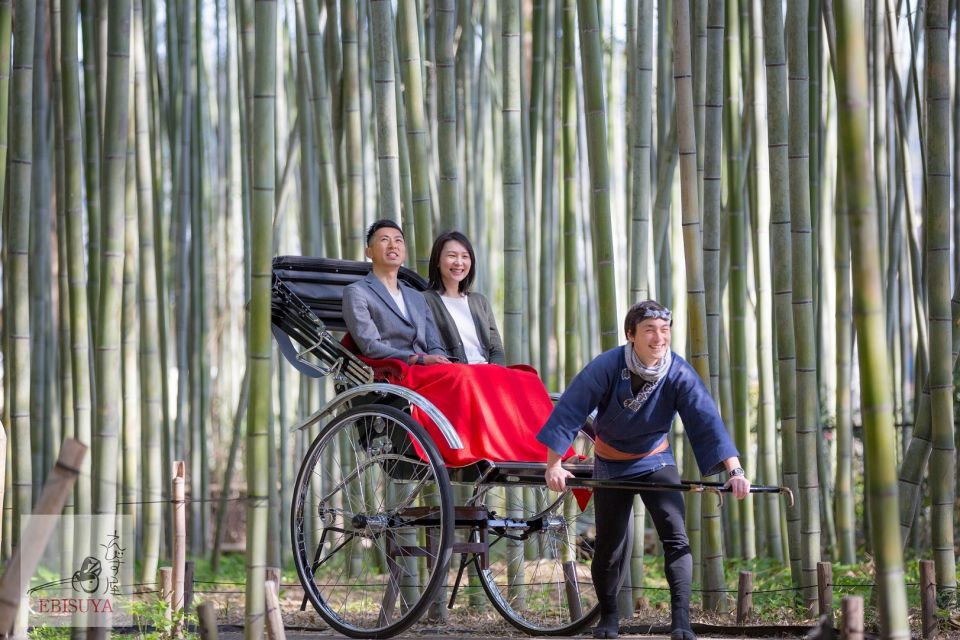
Against all those, a customised rickshaw tour through Arashiyama — €44.69, 539 reviews, in lengths from 45 minutes to over three hours — is described by its operator as wheelchair- and stroller-friendly.
It is also, on the same page, listed as not suitable for pregnant women or people with back problems, and not recommended for expecting mothers in their first 16 weeks.
Both statements are theirs, side by side. They are not necessarily contradictory — a rickshaw seat is a firm bench on large wheels over uneven ground, which is a very different question from whether a wheelchair user can be helped aboard. But they cannot both be answered from the listing. Write to the operator and describe your actual situation before you pay. A rickshaw is one of the few ways to cover the bamboo grove and the river road without walking it, which makes it worth the email.
The temples, and how much of each is reachable
We could not obtain access statements from every temple’s own site, and we are not going to invent them. What follows is from a specialist Japan accessibility guide, not from the temples themselves — treat it as a starting point to confirm, not as the temple’s word.
| What the access guide describes | Confirm before relying on it | |
|---|---|---|
| Kiyomizu-dera | marked route from the main entrance stairs round to a side entrance; main hall and the wooden stage reachable by ramp; no lift; one steep, narrow slope; stairs cut off the paths deeper in; two accessible toilets | yes |
| Kinkaku-ji | packed gravel path to the pavilion viewpoint is passable; the garden above it has steps; rental wheelchairs and accessible toilets available | yes |
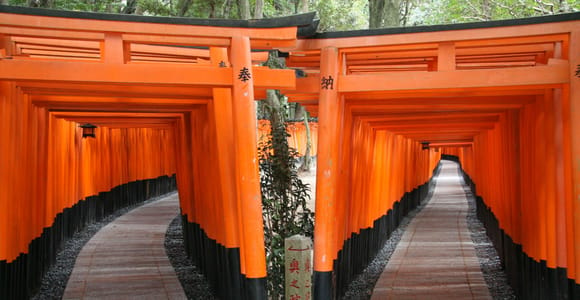
| Fushimi Inari Taisha | free, no gate; the precinct at the base is broadly manageable; the Senbon Torii climb up the mountain is stone steps and is not passable | yes |
Two things in that table matter more than the rest.
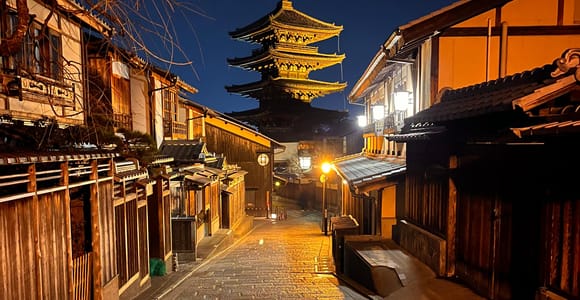
At Kiyomizu-dera the hardest part is before the temple. The approach from the bus stops is described as a ten-minute walk uphill — the lanes of Ninenzaka and Sannenzaka, which are the steepest, most crowded and most photographed slopes in the city. A taxi can set you down near the top, and on this hill that is not a luxury, it is the difference between the visit happening and not happening.
At Fushimi Inari the famous part and the accessible part are different places. The shrine at the base is free and open with no gate at all; the endless torii tunnels that people come for climb a mountain on stone steps. Going and seeing the lower approach is a real visit. Expecting the photographs is not.
On fees, where the guide itself is out of date: Kiyomizu-dera raised its entry to ¥500 in April 2024, ¥200 for elementary and middle school pupils. The access guide reports that this entry may be waived on production of disability identification, and that Kinkaku-ji discounts for certificate holders. Japanese sites commonly extend this to one accompanying person. Carry your documentation — and ask at the window rather than assuming either way.
Transport, honestly
Getting around Kyoto covers the passes and why the subway’s two lines are the catch. For this question, the short version:
The subway is the most predictable option and has the fewest surprises underground, but it reaches only a fraction of the sights — most of the temples are a bus ride or a long walk from a station. The buses are crowded at the hours everyone travels. Taxis are the tool that solves the specific problem above: the last, steep, cobbled ten minutes.
We have not verified vehicle-by-vehicle accessibility of Kyoto city buses, and we will not summarise it from memory. If a bus route is load-bearing in your plan, that is a question for the operator on the day.
Two more things worth knowing before you book
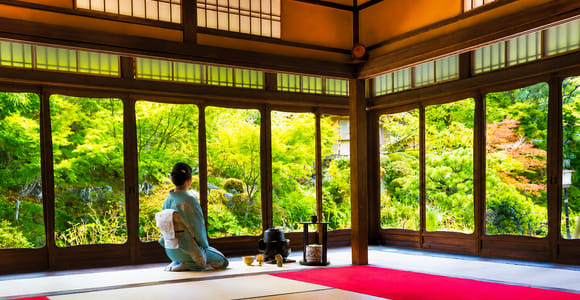
A tea ceremony means kneeling on tatami. Several Kyoto operators run table-style ceremonies precisely because seiza is not possible for everyone — including one in a century-old machiya. Which ones, and what changes, is in what a Kyoto tea ceremony actually gets you. Say when you book; it is a routine request here, not an imposition.
Arashiyama’s monkey park is out. Two operators independently describe the access as a 15 to 20 minute steep climb with several flights of steps. There is no alternative route. The rest of Arashiyama — the river road, the bamboo path, the train along the gorge — is a genuinely good day without it, and is set out in Arashiyama in one day.
Where to start
Begin with the operators who state a position rather than the ones who say nothing, because a stated position is one you can hold them to. The guided tours of Kyoto and the Arashiyama tours both include private options, and a private tour is the one format where the route can be built around your actual constraints rather than around an itinerary.
Then ask, in writing, describing your actual situation rather than asking whether somewhere is “accessible”. A listing has to cover everyone; an answer to a specific question only has to cover you.
Everything above is quoted from operators’ booking pages or from a specialist accessibility guide, as marked, on the date at the top. None of it is a guarantee, and access arrangements change — confirm the ones your day depends on.