What to See in Kyoto: What Is Free, What Is Ticketed, What Is Shut on Tuesdays
Updated September 17, 2026 · 8 min read
Kyoto was the imperial capital from 794 until the middle of the 19th century, and UNESCO lists the result as one property in seventeen parts: 198 buildings and 12 gardens, all of them religious establishments except one castle.
That sentence contains the first trap. Two of the seventeen are not in Kyoto. Byōdō-in stands in Uji, a separate city to the south, and Enryaku-ji sits on Mount Hiei in Ōtsu — a different prefecture altogether. The listing is called Historic Monuments of Ancient Kyoto (Kyoto, Uji and Otsu Cities), and people who set out to “see all seventeen” in three days usually find that out on day two.
The six places a first visit actually converges on
Almost every itinerary, guided or not, ends up at the same handful. What matters is which of them have a gate and which do not.
| Ticket? | Hours | |
|---|---|---|
| Fushimi Inari Taisha | No | No gate, no ticket office |
| Arashiyama bamboo path | No | Open path, no gate |
| Gion and the Higashiyama lanes | No | Streets – but see the rule below |
| Kiyomizu-dera | Yes | Opens 6 am, closing varies by season |
| Kinkaku-ji (Golden Pavilion) | Yes | 9 am – 5 pm |
| Nijō Castle | Yes | 8:45 am – 4 pm last entry, gates close 5 pm |
Three of the six are free and two of those have no entrance at all. This is the single most useful thing to know before you build a budget: in Kyoto, the money goes on transport and time, not on admission. A day that takes in Fushimi Inari in the early morning, walks the Higashiyama lanes and finishes in Gion costs you bus fares and nothing else.
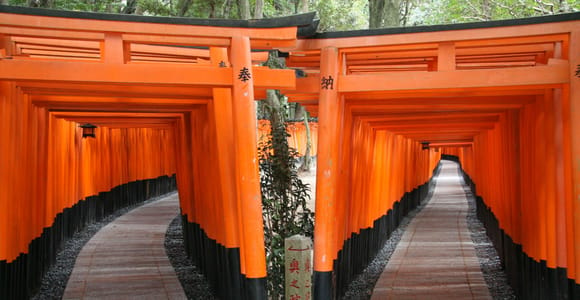
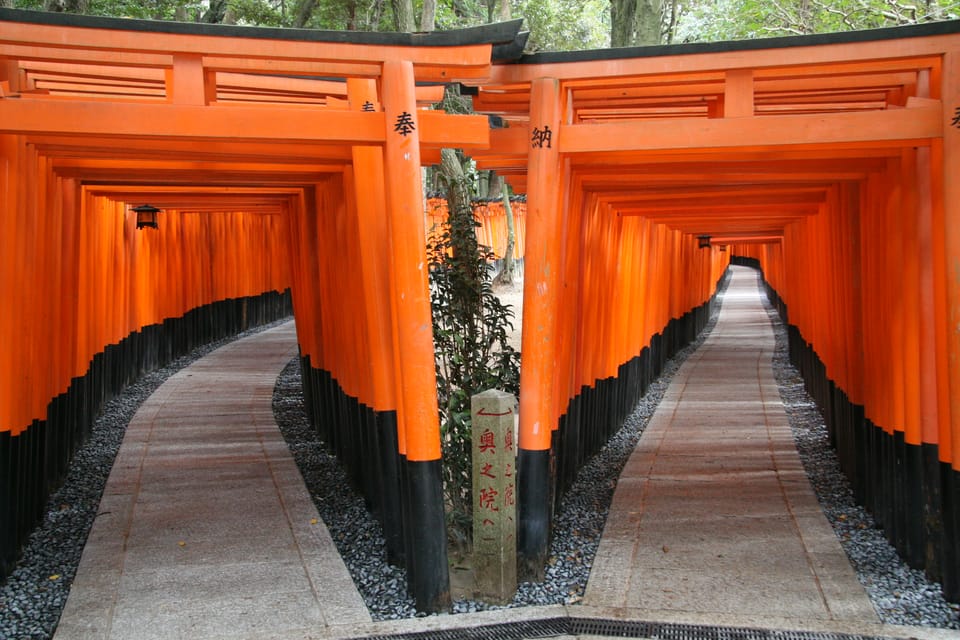
Fushimi Inari is the extreme case. The thousands of vermilion torii climbing the hill behind the main hall belong to a Shinto shrine – not a temple, and the distinction is not pedantry, it is what the signs say – and the shrine charges nothing to walk through them. The shops along the approach keep daytime hours; the path does not.
The Tuesday problem, and why an opening time is not one number
Nijō Castle is the one non-religious component of the World Heritage listing, and the reason to go is the Ninomaru-goten Palace: the audience rooms with the nightingale floors and the Kanō-school screens.
The palace is closed every Tuesday in January, July, August and December, while the castle around it stays open. The Honmaru-goten Palace has its own closures — the third Monday of each month and the day after — and needs a separate reservation.
So “Nijō Castle, 8:45 to 4” is true and useless on a Tuesday in August. The rule that follows from this applies all over Kyoto: when a site publishes hours for the grounds and hours for the single building you came for, the stricter number is the one that decides your day.
The current rates at Nijō, from the castle’s own fee page: ¥800 for the castle, ¥1,300 for the castle with Ninomaru-goten, ¥1,000 for Honmaru-goten on its separate ticket, ¥100 for the painting gallery. Children under school age enter free.
Admission is going up, and one temple has already doubled
Ginkaku-ji, the Silver Pavilion, raised its admission from ¥500 to ¥1,000 for adults on 1 April 2026, and from ¥300 to ¥500 for school children. That is not a rumour; it is on the temple’s own notice page, with the old and new figures side by side.
Kinkaku-ji belongs to the same Rinzai branch, Shōkoku-ji, and has posted its own revision notice — but publishes the figures as an image rather than as text, so we are not going to print a number we cannot read. Its hours are 9 am to 5 pm; check the fee on the temple’s notice page before you go, and expect it to be closer to Ginkaku-ji’s new rate than to the ¥500 that guidebooks have quoted for years.
This matters for planning more than it looks. Two adults doing four ticketed temples in a day used to be a ¥4,000 afternoon. At the new rates it can be double that, and three of the six places in the table above are still free.
The geography is a basin, and it punishes zig-zags
Kyoto sits in a valley ringed by hills on three sides, and the sights cluster at the edges:
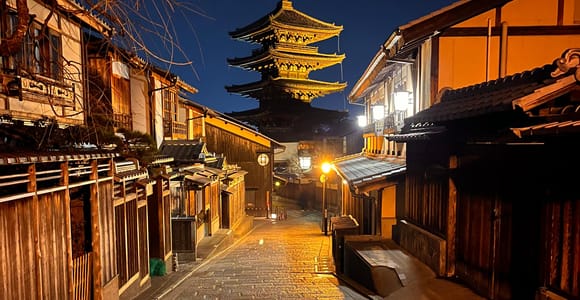
- East (Higashiyama) — Kiyomizu-dera, the Ninenzaka and Sannenzaka lanes, Yasaka Shrine, Gion, then north along the Philosopher’s Path to Ginkaku-ji. This is the walkable half day. Almost all of it is street-level and free.
- North-west — Kinkaku-ji and Ryōan-ji, close to each other and a long way from everything else.
- West — Arashiyama: the bamboo path, Tenryū-ji, the river.
- South — Fushimi Inari, Tō-ji, and the Fushimi sake breweries, all on the same rail line out of Kyoto Station.
Each of those four is a half day. Two of them in one day is a full day; three is a day spent on buses. The mistake that costs the most is pairing Arashiyama with Higashiyama — opposite ends of the basin, 50 minutes apart at best, and both of them places where the walking is the point.
What the guided version buys you
Our Kyoto inventory holds 706 tours and tickets, at a median of €58.83. The single offer with the most reviews is a full-day bus tour that strings together Kiyomizu-dera, Sanjūsangen-dō, Tenryū-ji, the bamboo grove, Kinkaku-ji and Fushimi Inari — 8 hours 30 minutes, €84.92, 4.8 stars from 5,313 reviews, with entry tickets and lunch included.
Whether that is good value depends on which half of the city you are looking at. It solves the hard problem — the four corners of the basin in one sitting, with the admissions handled — and it does it at roughly the price of the entries plus a taxi day. It solves nothing at all for the eastern lanes, which are free, flat and made for walking.
There is a cheaper structural answer too. The old ¥700 bus-only day pass was taken off sale in September 2023 and stopped being accepted at the end of March 2024, deliberately, to push visitors off the crowded buses. What replaced it is the Subway & Bus One-Day Pass at ¥1,100 for adults and ¥550 for children, valid on the city buses and both subway lines. A single city bus ride in the flat-fare zone is ¥230, so the pass pays for itself on the fifth ride — and the subway is where it earns its keep, because it is the part of the network that does not sit in traffic.
Three honest warnings
The lanes below Kiyomizu-dera are not a photo set. Gion’s private alleys have been closed to visitors since April 2024, with signs stating a ¥10,000 fine, and the Japanese text on those signs prohibits photography, tourist entry and guided tours. Hanamikoji and the marked public streets are fine, and so are the guided evening walks of the district that stay on them.
Your hotel bill changed this year. Kyoto’s accommodation tax was restructured on 1 March 2026 into five bands, charged per person per night: ¥200 under ¥6,000, ¥400 from ¥6,000, ¥1,000 from ¥20,000, ¥4,000 from ¥50,000 and ¥10,000 from ¥100,000. The old ceiling was ¥1,000. For a family of four in a mid-range room it is a rounding error; at the top end it is a real number, and it is per person, not per room.
Do not put the day trip on your first day. Nara, Osaka and Uji are close enough to tempt you — Nara is 35 minutes by limited express — but the basin takes a day to make sense of, and the day trips out of Kyoto will still be there on day three.
Where to start looking
- Temples, shrines, the castle and the palace: Kyoto temples and shrines
- The eastern lanes and the geiko districts: Gion and the geisha district
- The west: Arashiyama and the bamboo grove
- Sitting down for 45 minutes with matcha: Kyoto tea ceremonies
- Guided rounds on foot, by bike, by rickshaw or by bus: guided tours of Kyoto
- Nara, Osaka, Uji, Himeji: day trips from Kyoto
Hours, closures and fees in this article come from the operators’ and temples’ own pages on the date at the top. They are theirs to change — check the ones your plan depends on.