Gion's Rules: Which Lanes You May Walk, and What the ¥10,000 Sign Means
Updated September 17, 2026 · 7 min read
Gion is a working neighbourhood that happens to be famous, and the rules there are not a suggestion. They exist because residents and working geiko were being photographed without consent, followed, and cornered on their way to work.
Here is the current state of it, plainly.
What is closed and what is open
Since April 2024, visitors are not allowed in Gion’s private alleys. The no-entry signs at the entrances — the one on Kosode-koji lane was the first to go up, at the end of May 2024 — are trilingual, and the English reads: Private Road Do Not Enter Fine up to ¥10,000. The Japanese text on the same sign goes further, and it is the version worth knowing: it prohibits photography, entry by tourists, and guided tours.
That last word matters more than anything else in this article. Booking a guide does not buy you access. A guide who walks you down a private lane is breaking the same rule you would be.
This was not the first step. From 25 October 2019 an association of local residents and shopkeepers had already banned photography on the private streets, with the same ¥10,000 figure, and it is enforced with video rather than with anyone standing there — violators are identified afterwards. The 2024 measure closed the lanes to entry altogether.
What remains completely open:
- Hanamikoji, the main street through the southern district — the wide lane with the wooden façades that appears on every postcard
- every street marked as a public road, which is most of what a visitor would want to walk
- the Shirakawa canal side, with its willows and low bridges
- Pontochō, the narrow lane along the Kamo river, which is a public street
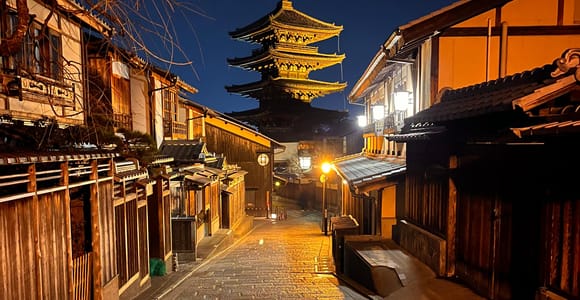
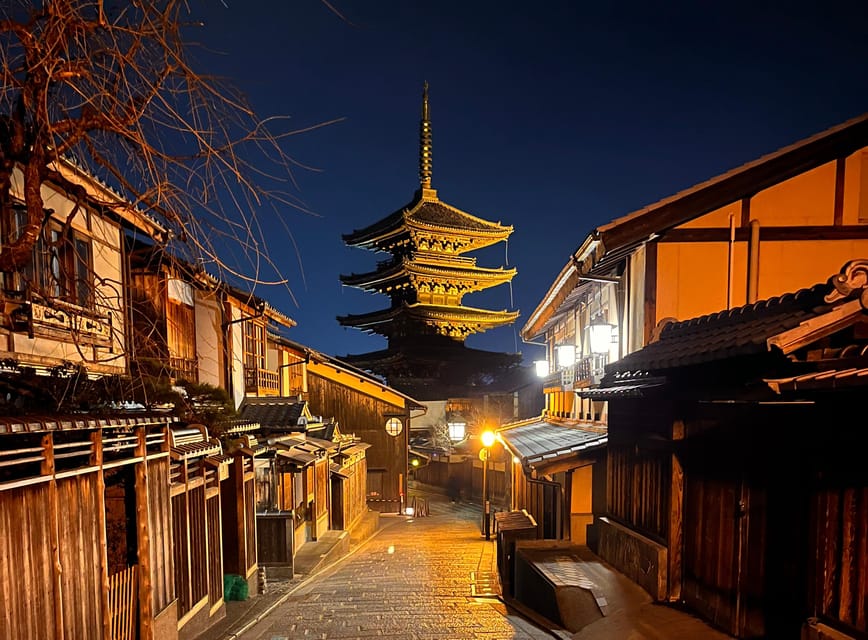
- the Ninenzaka and Sannenzaka lanes climbing towards Kiyomizu-dera, and the view up to the Yasaka Pagoda
In other words: the ban removes a handful of side passages, not the district. If your plan was Hanamikoji at dusk and a walk down to the river, nothing about it has changed.
The honest part: you probably will not see a geiko
There are about 90 Gion and geiko offers in our Kyoto inventory, and the four most-reviewed walking tours among them run between €18.90 and €21.01. None of them can promise you a geiko, because a geiko walking to an appointment is a person going to work, not a scheduled attraction.
What the well-run walks actually give you is the explanation: what the districts are, how the apprenticeship works, why the ochaya system means you cannot simply book a table, and which of the buildings you are looking at are teahouses rather than restaurants. That is worth two hours in a way that a sighting is not.
The most-reviewed of them is the evening walk through Gion — 100 minutes, €18.90, 4.9 stars from 4,608 reviews. There is a two-hour version at €20.11 with 4,597 reviews, a night walk at €21.01 with 4.9 stars, and a history-focused walk at €19.55.
If you want to be certain of seeing a geiko or maiko, you have to book a performance. Those are a different product and priced like one:
- a 15-minute geiko or maiko dance with the Gion museum, €22.35, 4.6 stars from 516 reviews — the short, cheap, honest version
- a one-hour show with a question-and-answer session and photographs, €50.84, 4.8 stars from 528 reviews
- a three-hour cultural walk with a show and dining options, €93.86, a full 5.0 stars from 653 reviews
The 15-minute dance is the one most people underrate. It costs about the same as a walking tour, it is a guaranteed sighting in a setting where being photographed is part of the arrangement, and it takes a quarter of an hour.
Most of the “geisha” in your photos are tourists
Our inventory holds 43 kimono and yukata offers, from €12.29, and one of them alone has 1,342 reviews. On a spring or autumn afternoon the Higashiyama lanes are full of visitors in rented kimono with their hair done.
That is the plain explanation for a thing many people notice too late: the figure you photographed in the lane was almost certainly another visitor. A working maiko walks quickly, in the early evening, usually with a purpose and often accompanied. She is not posing, and she is not stopping.
There is nothing wrong with renting a kimono — it is one of the most popular things to do in the city, and our kimono rental page lists what is on offer. It is worth knowing which of the two you are looking at.
Six rules that keep you on the right side
- Stay on the public streets. If a lane has a sign, that is your answer. When in doubt, it is a private road.
- No photographs of people without asking. This applies to geiko, to residents, and to the insides of doorways.
- Do not stop, touch, follow or block. Walking backwards in front of someone to get a shot is the behaviour the rules were written for.
- Do not step into doorways or entrance passages to frame a shot. The entrance of an ochaya is private ground, sign or no sign, and littering in the lanes is one of the complaints that produced the rules in the first place.
- Keep your voice down after dark. People live above those façades.
- Assume your guide knows the boundary — and that “hidden alleys” in a tour title means public backstreets. If a booking page promises access to private lanes, that is a promise it cannot keep.
When to go, and when not to
Evening is the point of Gion. The lanterns come on, the streets empty of day-trippers, and the district looks like the thing you came for. The best-reviewed walks are the evening and night ones, and that is not marketing.
The hour to avoid is late afternoon in cherry blossom or autumn foliage season, when the lanes below Kiyomizu-dera are a slow-moving queue and photography is a contact sport.
And a quiet suggestion: Pontochō, on the river, is a public street the whole way, and at eight in the evening it does most of what people go to Gion for, with a fraction of the crowd.
Where this fits into a first visit is set out in what to see in Kyoto. The guided walks themselves are all on our Gion and geisha district page, and the district also sits on most guided tours of Kyoto.
The rules above are the district’s own, as posted on its signs; prices and review counts are from our inventory on the date at the top and move. Check both before you book.