Kansai from Kyoto: Which Day Trip Is Worth the Train, and Which Is Not
Updated September 17, 2026 · 8 min read
Kyoto sits in the middle of Kansai, and that is a mixed blessing. Half a dozen places worth a full day each are within an hour of Kyoto Station, which is exactly why first-time visitors lose two days of a five-day trip to railways and regret it.
The question that sorts them out is not “how far?” It is: does Kyoto already have something of the same kind? Kyoto has more temples and gardens than anyone can see in a week. So a day trip only earns its train ticket if it offers something Kyoto genuinely does not have — and three of the candidates below do, while one of them mostly does not.
The fares, before the sightseeing
Journey times and fares from Kyoto Station, one way, standard class:
| Fastest | Fare | Covered by the Japan Rail Pass? | |
|---|---|---|---|
| Nara (Kintetsu limited express) | 35 min | ¥1,280 | No – Kintetsu is a private railway |
| Nara (Kintetsu express) | 45 min | ¥760 | No |
| Nara (JR Nara Line, Miyakoji rapid) | 45 min | ¥720 | Yes |
| Osaka (JR special rapid, city centre to city centre) | 30 min | ¥580 | Yes |
| Osaka (Shinkansen to Shin-Osaka) | 15 min | ¥1,450 | Yes |
| Himeji (JR special rapid) | 1 hr 35 min | ¥2,210 | Yes |
| Himeji (Shinkansen, direct) | 45 min | ¥4,840 | Yes — Hikari/Sakura, not Nozomi |
| Hiroshima (Nozomi shinkansen) | 1 h 40 min | ¥10,770 | Not on the pass alone |
Two rows in that table decide most people’s plans.
Himeji is the one case where the shinkansen earns its fare. ¥4,840 against ¥2,210, but 45 minutes against 1 hour 35. The fast train saves close to an hour each way, nearly two hours out of a day trip. With a rail pass, take the Hikari; the Nozomi is not included.
Nara has three sensible options and the cheapest is not the worst. The Kintetsu limited express is the quickest at 35 minutes, but the detail that matters is where you get off: Kintetsu-Nara station is a few minutes’ walk from Nara Park, while JR Nara station is a 15 to 20 minute walk west of it. So the ¥720 JR rapid — the one a rail pass covers — costs you roughly half an hour of walking across the day. With a pass, take it. Without one, the ¥760 Kintetsu express is the same 45 minutes and puts you at the park gates.
Nara: the one that is genuinely different
Nara was the capital before Kyoto was, and the two things it has are things Kyoto does not.
The first is the Daibutsuden at Tōdai-ji, the Great Buddha Hall, with a bronze Buddha of a scale that has no equivalent in Kyoto. The temple’s own hours: 7:30 am to 5:30 pm from April to October, 8 am to 5 pm from November to March. Admission is ¥800 for adults and ¥400 for children aged 6 to 12; a joint ticket with the Tōdai-ji Museum is ¥1,200 and ¥600.
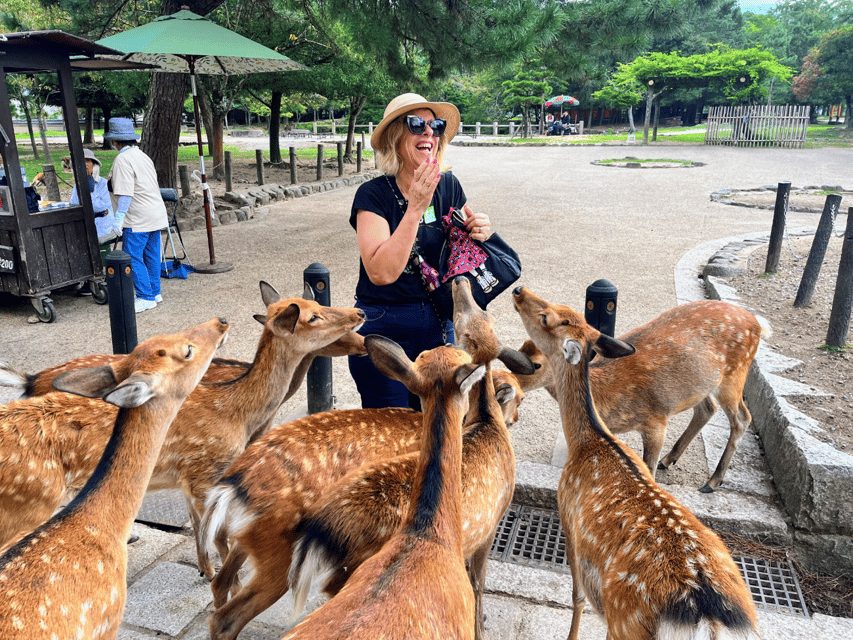
The second is the deer, and this is where the honest version differs from the postcard. The Nara Deer Preservation Foundation’s July 2026 count recorded 1,687 deer in the park — 411 stags, 990 does, 286 fawns. The year before it was 1,465, itself the highest since the present survey method began in 1953. They are unfenced wild animals, not a petting zoo. They do bow for the crackers sold from stalls in the park; they also butt, nip and shove, particularly at someone holding a packet and hesitating.
The deer consultation office in Nara Park logged 100 injured visitors in the 2023 financial year to the end of February — 53 from abroad and 45 Japanese. The prefecture names September as the peak month, when the stags come into rut and are at their least patient. If your trip falls in autumn, that overlaps with the window when the foliage is at its best.
So: feed the crackers fast or not at all, keep paper maps, tickets and paper bags out of reach, and do not put a small child between a stag and a cracker seller. This is the part of the day that goes wrong with children, and it goes wrong because the animals behave exactly as wild animals do.
A guided version exists if you would rather not work out the geography: the morning tour from Kyoto runs four hours and takes in Tōdai-ji, Nara Park and Kasuga Taisha, at €67.04, 4.6 stars from 440 reviews. Be clear-eyed about what that is: the train is ¥720. You are paying for the guiding, the pacing and not having to think — which for half a day with a tight schedule can be worth it, and on a slow trip is not.
There is also a bus tour that bolts Nara onto Fushimi Inari and Arashiyama in one day — €45.39, 4.8 stars from 3,281 reviews, and 9 to 10 hours long. It is the cheapest way to see all three and the reason is visible in the duration. Nine hours to cover two cities means none of them for long.
Osaka: different in kind, not in degree
Osaka is 30 minutes and ¥580 away, station to station, and it is the one trip where the shinkansen is actively worse — Shin-Osaka is not in the city centre, so the 15-minute train drops you further from where you are going.
What Osaka has that Kyoto does not is loudness: canal-side neon, a food culture that happens standing up, and evenings that do not end at nine. The Dotonbori river cruise is 20 minutes long, €11.17, 4.6 stars from 2,086 reviews, and is the compressed version of exactly that.
Osaka is also the day trip that works in reverse. If your evenings are the problem — Kyoto’s centre is quiet after dinner — an evening in Osaka and a late train back is a better use of the line than a whole day.
Uji, Ōtsu and the two World Heritage sites that are not in Kyoto
The UNESCO listing Historic Monuments of Ancient Kyoto has seventeen parts, and two of them are outside the city: Byōdō-in in Uji and Enryaku-ji on Mount Hiei in Ōtsu, which is in Shiga Prefecture.
Uji is the easy one. It sits on the JR Nara Line, the same line as Fushimi Inari and Nara, which means it fits into the Nara day rather than needing one of its own. It is also the centre of Japanese green tea: the tea museum with matcha grinding is an hour, €20.11 and 4.9 stars from 1,034 reviews — a different thing from a tea ceremony in the city, and closer to how the tea is actually made.
Ōtsu and Lake Biwa are the least-visited direction out of Kyoto and the most obviously under-sold: Japan’s largest lake, a working city on its shore, and a mountain monastery at the top of the funicular. If you have a fourth day and have had enough of crowds, this is where they are not.
The best-reviewed day trip leaves Kansai altogether
The highest-rated day trip in our Kyoto inventory is Hiroshima and Miyajima — 8 hours, €106.15, a full 5.0 stars from 3,913 reviews. It deserves the rating. It is also not in Kansai, and the numbers explain why it is a different proposition from everything above: 1 hour 40 minutes each way on the fastest shinkansen, ¥10,770 one way at the unreserved fare, and the Nozomi service is not included in a Japan Rail Pass without paying a supplement.
Three and a half hours of travelling, for a place that asks to be taken seriously. Do it as an overnight, or do it as a guided day and accept that the day is the trip. What it is not is a half-day add-on, and the star rating can make it look like one.
Amanohashidate on the north coast has the same shape of problem in a prettier package: the day tour with the Ine boat houses is €45.25 and 4.9 stars from 591 reviews, and runs 10 hours. Still Kyoto Prefecture, still most of a day in a coach.
How to spend the days you have
- Three days in total. No day trips. Kyoto’s own four corners are three days, and the temples and shrines alone will not run out.
- Four days. One day in Nara, going out early and back by mid-afternoon — the deer and the Daibutsuden are worth a train.
- Five days. Add Osaka, and put it in the evening rather than the day.
- A week. Himeji by special rapid, or Ōtsu and the lake. Hiroshima only if you are willing to sleep there.
Everything above leaves from Kyoto Station, which makes the choice of hotel matter more than the choice of trip. The full range of guided options sits on our day trips from Kyoto page; if you would rather stay in the city, start with guided tours of Kyoto, the tea ceremonies, Arashiyama or Gion.
Fares, times and opening hours here are the operators’ and temples’ own figures on the date at the top, and they change. Check the ones your day depends on.