Kyoto Temple Hours and Tickets: The Numbers That Ruin Plans
Updated September 17, 2026 · 7 min read
The UNESCO listing for Kyoto covers seventeen component parts — 198 buildings and 12 gardens — and every one of them keeps its own hours, sets its own fee and closes on its own days. There is no city pass, no shared timetable and no single closing time.
That is the whole problem, and it produces the same three mistakes over and over.
Mistake one: reading the site’s hours instead of the room’s
Nijō Castle is open 8:45 am to 4 pm for last entry, with the gates closing at 5 pm. True, and useless on the wrong day.
The Ninomaru-goten Palace — the audience rooms with the painted screens, the reason people come — is closed every Tuesday in January, July, August and December. The castle around it stays open on those Tuesdays. The Honmaru-goten Palace closes on the third Monday of each month and the following day, and needs a separate reservation.
So one address has at least three different calendars. The rule that follows applies across the city: when a place publishes hours for the grounds and hours for the single building you came for, the stricter number decides your day.
The fees at Nijō, from the castle’s own page: ¥800 for the castle, ¥1,300 for the castle with Ninomaru-goten, ¥1,000 for Honmaru-goten on its own reserved ticket, ¥100 for the painting gallery. Junior and senior high school pupils pay ¥400, elementary pupils ¥300, and children below school age go free. The castle also closes 29 to 31 December.
A guided hour of the castle and the palace costs €13.97 and has 4.7 stars from 1,227 reviews — which, next to a ¥1,300 ticket, is close to the price of the entry itself.
Mistake two: assuming everything opens at nine
Most of it does. Two of the busiest places do not.
| Opens | Ticket | |
|---|---|---|
| Fushimi Inari Taisha | No gate, no closing time | None |
| Kiyomizu-dera | 6 am–6 pm (6:30 pm in July/August) | Yes |
| Kinkaku-ji | 9 am – 5 pm | Yes |
| Nijō Castle | 8:45 am, last entry 4 pm | Yes |
| Arashiyama bamboo path | Open path, no gate | None |
Kiyomizu-dera opens at six in the morning. That is the temple’s own figure, and it closes at 6 pm, or 6:30 pm in July and August, with last entry at 9 pm during the evening openings. Six o’clock is three hours before the coaches, on the single busiest slope in Kyoto.
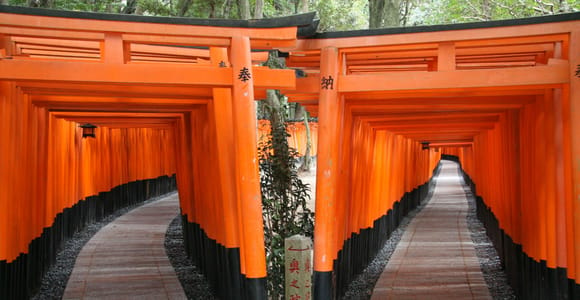
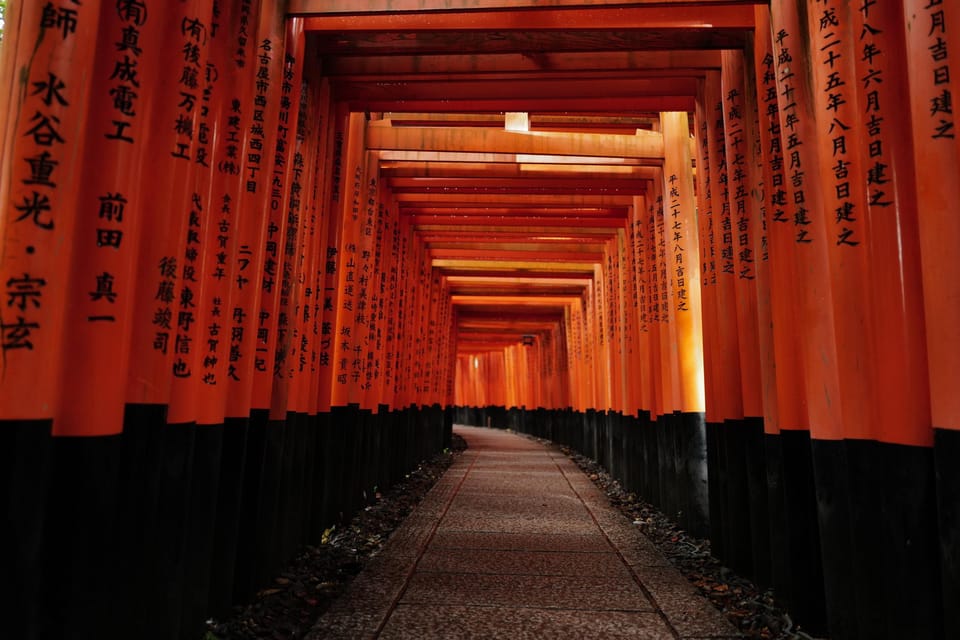
Fushimi Inari has no gate at all. The shrine charges nothing and the torii paths are walkable at any hour; the shops along the approach keep daytime hours, the hillside does not. Between them, those two facts are the entire argument for an early start — and the reason the early tour below exists.
The early-morning round of Fushimi Inari, Arashiyama and Kinkaku-ji runs six hours at €57.01, with 4.9 stars from 1,621 reviews — the highest of any tour that links several Kyoto stops in one day; the bus tours rated above it in our inventory all leave the city. The difference is the hour it starts.
Mistake three: using a fee you read last year
Ginkaku-ji, the Silver Pavilion, doubled its admission on 1 April 2026. From the temple’s own notice, with old and new side by side: adults, high school and above, ¥500 → ¥1,000. Elementary and junior high pupils, ¥300 → ¥500. Pre-school children remain free, and the reduced rate for visitors with a disability stays at ¥100.
Kinkaku-ji belongs to the same Rinzai branch, Shōkoku-ji, and has posted its own revision notice — but publishes the figures as an image rather than as text. We are not going to print a number we cannot read. Its hours are 9 am to 5 pm; take the fee from the temple’s notice page on the day you plan, and budget nearer to Ginkaku-ji’s new rate than to the ¥500 that has been quoted for years.
What this does to a day is arithmetic. Four ticketed temples for two adults used to be around ¥4,000. At the new rates it can be twice that — while Fushimi Inari, the bamboo path and the Higashiyama lanes remain free.
Two facts worth building a plan on
Last admission is not closing time. At Nijō the gap is exactly an hour. Anywhere with a garden, the last-entry time is the one that matters, because the walk after the gate takes as long as it takes.
Two of the seventeen World Heritage components are not in Kyoto. Byōdō-in is in Uji and Enryaku-ji is in Ōtsu, in Shiga Prefecture — see Kansai from Kyoto for what that costs in train time. It also means the seventeen cannot be done as a city itinerary, which is worth knowing before anyone tries.
The shape of a day that works
- 6 to 8 am — Kiyomizu-dera, or Fushimi Inari. Both are open, one is free, and neither is crowded.
- 9 am — the ticketed temples as they open: Kinkaku-ji, Ryōan-ji, Nijō Castle.
- Midday — the free, shaded, street-level part: the Higashiyama lanes, the Philosopher’s Path.
- Late afternoon — the bamboo path in Arashiyama, or Gion as the lanterns come on.
- Not on a Tuesday in January, July, August or December — Ninomaru-goten. Go on another day, or go to the castle knowing the palace is shut.
Guided versions of most of this are on our temples and shrines page and among the guided tours of Kyoto; the full first-visit picture is in what to see in Kyoto, and the west of the city has its own page for Arashiyama.
Every hour and fee above is from the temple’s or castle’s own pages on the date at the top. They are theirs to change, and one of them changed this year — check the ones your plan depends on.